How to Get a Beard Waiver in the Military — 2026
Military beard waivers have gotten complicated with all the policy noise flying around — and if you’re pulling from a guide written before late 2025, you’re probably working with information that could get you separated. As someone who spent several years helping soldiers navigate the medical documentation process at Fort Campbell, I learned everything there is to know about how badly incomplete paperwork can sink an otherwise solid case. The guys who showed up without their treatment notes attached, or — worse — had no idea the 12-month cap even existed, were genuinely alarming to deal with. This covers where things actually stand in 2026, including the DoD directive that rewrote the rules on how long a medical waiver can cover you.
PFB Diagnosis and Treatment Options
Probably should have opened with this section, honestly. None of the waiver process matters until you have an actual diagnosis in hand.
But what is pseudofolliculitis barbae? In essence, it’s a chronic inflammatory skin condition where shaved hair — particularly tightly coiled hair — curls back and re-enters the skin before clearing the follicle. But it’s much more than that. The immune response it triggers produces papules, pustules, and over time, hyperpigmentation and scarring that looks and feels nothing like ordinary razor burn. It disproportionately affects Black men, though anyone with tightly coiled facial hair can develop it. It is not a hygiene problem. It is not a grooming problem. It’s a documented dermatological condition with decades of treatment literature behind it.
The diagnosis has to come from a military treatment facility provider — not an off-post urgent care, not a civilian dermatologist you’re seeing on your own dime. That referral chain matters. A lot. Your primary care manager at the MTF does the initial assessment, then kicks a referral to dermatology. Expect that appointment to run two to six weeks out depending on your installation. Fort Bragg’s dermatology clinic was sitting around five weeks when I last had visibility into their scheduling in late 2025.
Treatment alternatives to shaving include:
- Growing the beard past 5mm so the hair shaft clears the follicle before it curves back into the skin
- Topical retinoids — tretinoin 0.025% cream is commonly prescribed, used nightly to accelerate cell turnover
- Eflornithine hydrochloride cream (brand name Vaniqa, roughly $80–$120 per tube without formulary coverage) to slow hair regrowth
- Low-potency topical corticosteroids for acute flare management
- Laser hair removal — increasingly available at MTFs, near-permanent results after four to eight sessions
Whatever your dermatologist documents becomes part of your medical record and feeds directly into your DA Form 3349-SG. What’s on that form determines what your commander can authorize — and for how long.
Medical Waiver Process Step by Step
Frustrated by a profile that kept getting rejected and documentation gaps he couldn’t explain, one soldier I worked with rebuilt his entire packet from scratch using the sequence below — a plain manila folder, printed AHLTA notes, and one very patient JAG attorney. His waiver was approved within 18 days of resubmission. Here’s how the process actually works in 2026.
Step 1 — Get the Dermatology Referral on Record
Your PCM initiates the referral through the MTF referral management office. Keep a copy of every AHLTA or MHS Genesis note generated at that visit. The date of that referral is your timeline anchor — everything downstream gets measured from it.
Step 2 — Attend the Dermatology Appointment and Get the Diagnosis Coded
PFB falls under ICD-10 L73.1. Confirm with the dermatologist that this exact code appears in the visit documentation before you walk out of the clinic — ask to see the after-visit summary right there in the room. If the provider codes it as generalized folliculitis instead, the downstream paperwork gets messy fast. Don’t make my mistake of assuming it was entered correctly and finding out three weeks later it wasn’t.
Step 3 — DA Form 3349-SG
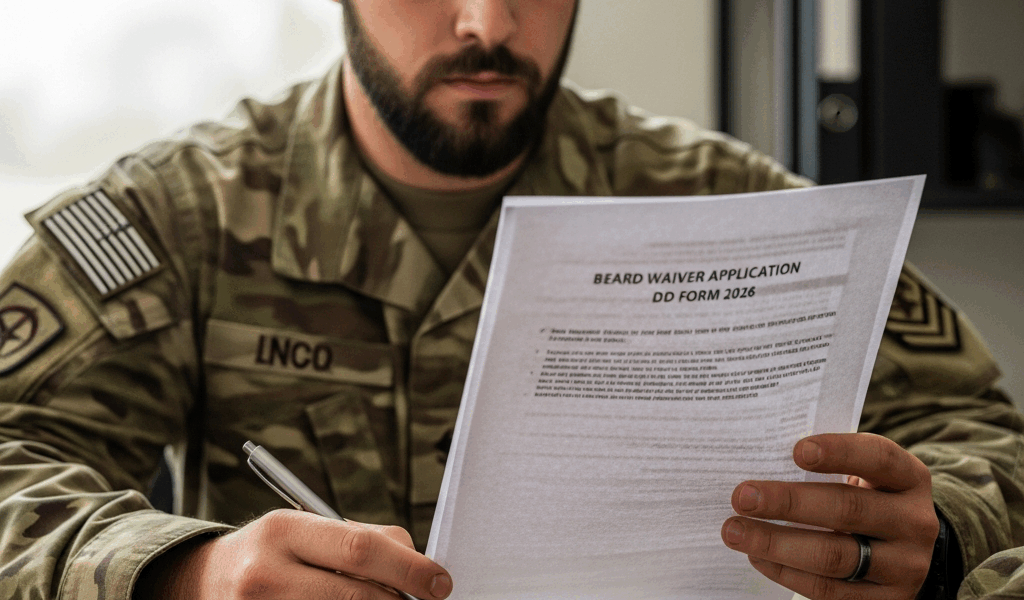
The DA Form 3349-SG is the Physical Profile Serial Report — the form that formally restricts what a soldier can be required to do. For a beard waiver, the relevant restriction goes in Part III under the “S” PULHES factor. The dermatologist or MTF physician fills it out. It specifies authorized beard length — typically 1–5mm or up to a full beard depending on severity — and the profile duration.
One thing I’ve seen go wrong repeatedly: soldiers bring the 3349-SG to their commander without a treatment plan attached. That form needs to travel with a copy of the dermatology treatment notes. Commanders aren’t required to approve anything that arrives without clinical substantiation behind it.
Step 4 — Commander Memorandum
Your unit commander issues a memorandum acknowledging the medical profile and authorizing the beard in accordance with AR 670-1 as modified by the profile. This memo goes into your official file. It is not optional. Without it, the 3349-SG is clinically valid but administratively unenforceable at the unit level — NCOs in your chain won’t have clear authority to allow it, and you’ll end up having the same argument with a different staff sergeant every two weeks.
The memo should reference the 3349-SG by date and profile number, state the authorized beard length in millimeters, and include the waiver’s expiration date. Keep a laminated copy on your person. Keep a digital copy on your phone. Seriously.
Step 5 — Follow-Up Appointments
The dermatologist should be scheduling follow-up at 30, 60, and 90 days minimum. These aren’t just good medicine — they generate the continued documentation you’ll need if you’re approaching the 12-month limit and building a case for extended retention or exploring other options. Skipping these appointments is how soldiers end up at month eleven with nothing to show a physician but a single diagnosis note from the previous year.
The 12-Month Limit — What It Means
This is the part that changed. The 2025 DoD directive — implemented across all service branches and fully in effect as of early 2026 — introduced a 12-month ceiling on continuous medical beard waivers for PFB. Under the old policy, a profile could be renewed indefinitely as long as the condition persisted. That’s no longer the case.
What the new policy actually says: if a service member has been on a continuous medical beard waiver for 12 months and the condition hasn’t resolved to the point where shaving is medically tolerable, the command is required to initiate a review. That review can produce three outcomes.
- Medical separation — if the condition is determined to be permanently incompatible with grooming standards, the soldier may be referred to a Medical Evaluation Board
- Retention with continued profile — if the MTF physician and command surgeon certify that treatment is ongoing and progressing, the profile can be extended, but this requires written physician justification, not just a dermatology referral
- Conversion to religious accommodation — if the soldier has a sincere religious belief requiring an uncut beard, the command may facilitate a transition to the religious accommodation process instead
The practical implication is real. Soldiers who’ve been rolling 90-day profiles without building a substantive treatment record are now at separation risk when month twelve hits. A profile alone isn’t enough anymore. You need documented treatment attempts, documented follow-up, and documented clinical rationale explaining why the condition hasn’t resolved.
If you’re sitting at or near 10 months on a continuous medical beard waiver right now — get to the MTF. Not in two weeks. Now. Request an updated dermatology evaluation and make sure your physician is documenting treatment progress, or lack of it, with clinical specificity. Vague notes won’t hold up at a review board.
Religious Accommodation — Different Process
The religious accommodation pathway is governed by DoDI 1300.17 and AR 600-20, and it operates entirely separately from the medical waiver process. That distinction matters enormously — religious accommodations, once approved, are not subject to the 12-month limit.
Requests go through the unit chaplain and chain of command up to HQDA level for initial determinations. The process typically runs 30 to 90 days. An approved accommodation authorizes a full beard with no length restriction framed in medical terms, though commanders retain authority to impose reasonable neatness standards under unit policy. That’s what makes the religious accommodation route endearing to us who’ve watched soldiers fight the same medical renewal battle every three months for years.
The sincerity standard is real. You’ll be evaluated on whether the belief is sincerely held — not whether it’s theologically mainstream or whether your chain of command personally finds it credible. Sikhs, Muslims, and members of certain Jewish communities have established precedent here. Approval rates for first-time requests have improved meaningfully since the 2022 policy revisions, apparently.
One important note — you cannot be on an active medical beard waiver and simultaneously file a religious accommodation request for the same beard, using the medical profile as a bridge while the accommodation processes. Commands have flagged this as a dual-filing issue, and it can complicate both requests. If you’re pursuing religious accommodation, talk to your JAG attorney before you file anything. Submit the accommodation because it reflects a sincere, independently documented belief — not as a tactical response to hitting month twelve on your medical profile.
The bottom line in 2026: the system still exists, it still protects soldiers with legitimate PFB diagnoses, but the margin for administrative sloppiness has narrowed considerably. Build your packet right from day one. Know your 12-month clock. And if religious accommodation applies to your situation, treat it as its own separate path — not a backup plan when the medical waiver runs out.



Leave a Reply