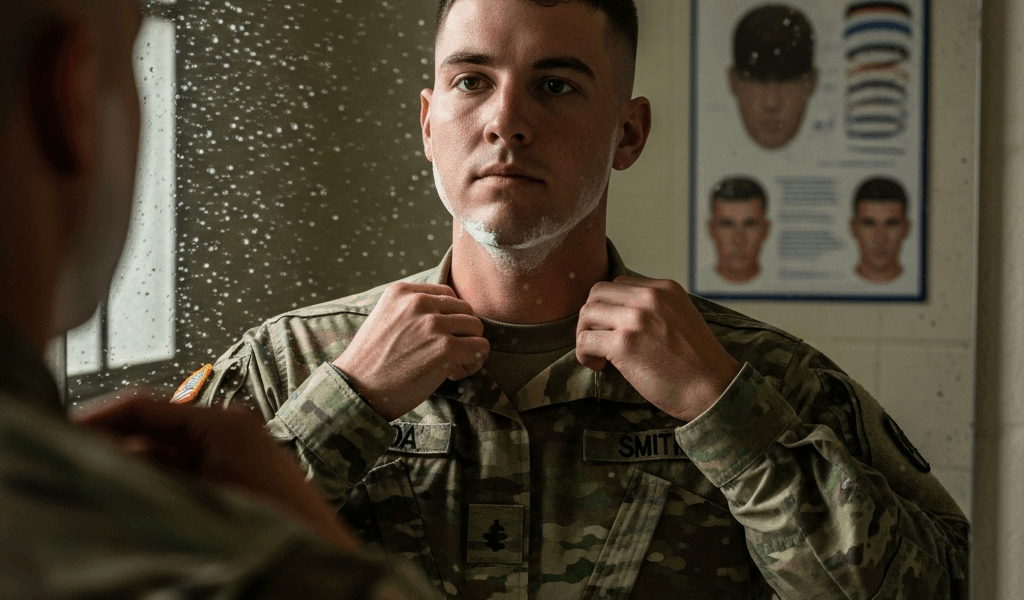
Working alongside personnel from the Army, Navy, Air Force, Marines, Coast Guard, and Space Force daily gave me a front-row seat to the enforcement gap between, say, a Space Force tech sergeant and a Marine staff NCO. I’m also the guy who once got pulled aside by a Master Sergeant over a sideburn allegedly 0.2 inches too long. It was a Tuesday. I had been awake for 22 hours. We’re not relitigating that — but the point holds. These regulations matter, and tracking six separate regulatory documents simultaneously is genuinely confusing.
Most coverage online handles one branch at a time. Army grooming standards in one article, Air Force in another. That format makes real comparison almost impossible. So this is the side-by-side version nobody has actually bothered to write yet.
Mustache Rules Side by Side — All 6 Branches
Mustaches are the single most contested piece of facial hair across the military — every branch allows them in some form, but the specific rules are different enough to matter. What’s inspection-ready in the Navy could get you counseled in the Marine Corps before you’ve finished your first cup of coffee.
Here’s the full breakdown as of 2026, pulled directly from each branch’s current regulatory guidance: AR 670-1 (Army), AFI 36-2903 (Air Force), MILPERSMAN 1000-030 (Navy), MCO 6310.1 (Marines), COMDTINST M1020.6 (Coast Guard), and SFPAM 36-2903 (Space Force).
| Branch | Max Length | Width Restriction | Style Restrictions | Notes |
|---|---|---|---|---|
| Army | ¼ inch (6.35mm) from follicle | Must not extend past lip corners | No handlebar, no Fu Manchu | AR 670-1, para 3-2 |
| Air Force | ¼ inch vertical bulk | Corners of mouth, no wider | Neat, tapered — no styled extremes | AFI 36-2903 updated Jan 2025 |
| Navy | ½ inch bulk, neatly trimmed | No specific width rule — must look “neat” | No Fu Manchu; handlebar technically gray area | Most permissive interpretation in practice |
| Marine Corps | ¼ inch, trimmed to lip line | Must not extend beyond corners of mouth | Strict — inspected at each formation | MCO 6310.1 language is intentionally tight |
| Coast Guard | ½ inch from follicle | Corner of mouth rule applies | Neatness standard, some unit discretion | Less uniform enforcement than USMC |
| Space Force | ¼ inch bulk | Corners of mouth — same as Air Force | Mirrors AFI 36-2903 almost exactly | SFPAM 36-2903 is the governing doc |
A few things jump out immediately. The Navy’s ½-inch bulk standard is genuinely more permissive than the Army’s ¼-inch rule — that’s not a typo. Navy sailors can carry noticeably more mustache, full stop. The Space Force, despite being the youngest branch, didn’t reinvent anything here. They essentially photocopied Air Force regs with minor formatting changes. The Marine Corps uses the same dimensions as the Army on paper, but enforcement culture makes the practical experience far stricter. A Marine NCO is statistically more likely to have an actual ruler.
What “Bulk” Actually Means
But what is “bulk”? In essence, it’s the vertical thickness of the mustache — how far it protrudes from the face when viewed from the side. But it’s much more than a simple length measurement. It does not mean the length of hair along the upper lip. This distinction tripped me up early on, and I know I’m not alone in that. The ¼-inch standard measures projection, not the hair strand itself. Hairs can technically be longer if they lie flat against the lip. Most service members don’t know this and over-trim for years without realizing it.
The Fu Manchu Question
Every branch explicitly bans the Fu Manchu by name — except the Navy, whose regulations describe prohibited styles by characteristic rather than by name. In practice, a Navy chief will tell you the same thing an Army sergeant would. But that regulatory gap exists. At least one servicemember used it successfully in a formal counseling response as recently as 2024. I’m not recommending this approach. I’m just telling you what happened, and that the gap is real.
The New Beard Waiver Policy — What Changed
This is the section that actually affects the most people right now. In late 2024, a DoD-level directive — implementation memo DTM-24-007 — imposed a 12-month maximum duration on medical grooming waivers across all branches. Before this change, indefinite waivers were possible. A dermatologist could write a letter, the unit would file it, and barring a command review, that waiver could persist through an entire enlistment period.
That’s gone now.
Under DTM-24-007, medical beard waivers must be reviewed and reauthorized at the 12-month mark. The reviewing authority varies by branch — battalion surgeon in the Army, flight surgeon or medical officer in the Air Force, medical officer of the command in the Navy. Reauthorization requires updated documentation. An old letter from a civilian dermatologist isn’t sufficient on its own anymore. The service member needs a current evaluation, typically within 90 days of waiver expiration.
What Happens If the Waiver Lapses
Here is where service members are getting caught. If the waiver expires without reauthorization, the service member is technically in violation of grooming standards starting day one after expiration. Commands have discretion on how aggressively they enforce this — some give an informal 30-day grace window, others do not. Separation risk is real if other negative documentation already exists in the record. A lapsed waiver combined with prior counseling statements has resulted in administrative separation boards in at least three documented cases in 2025 across Army and Marine units.
The safe approach: calendar your waiver expiration date the day you receive it, initiate the medical appointment 90 days out, and get paperwork to your unit admin at least 30 days before expiration. That buffer isn’t in the regulation anywhere. It’s just reality — and the difference between a smooth reauthorization and a very bad week.
The Pseudofolliculitis Barbae Context
Most medical waivers involve pseudofolliculitis barbae — PFB — a condition disproportionately affecting Black male service members in which shaving causes severe ingrown hairs and skin lesions. The 12-month cap has been criticized openly by dermatology groups and military advocacy organizations, and honestly, the criticism is fair. PFB is a chronic condition. It doesn’t resolve in 12 months. Requiring annual re-documentation creates administrative burden without meaningful clinical rationale. That criticism is documented in the American Academy of Dermatology’s 2025 formal comments to DoD. Whether that pressure produces a policy revision by end of 2026 is genuinely unclear — but it’s being watched.
Religious Accommodation Process
Religious accommodation requests for beards operate on a completely separate track from medical waivers — different forms, different reviewers, different timelines. The governing framework is DoDI 1300.17, last substantively updated in 2023 with additional processing guidance added in early 2025.
The process works like this:
- Submit a written request through your chain of command to the first general officer or flag officer in your chain — the “first GO/FO.” Requests routed around the chain get returned. Every time.
- Include a personal statement explaining the religious basis, the specific practice requested (beard length, style, any head covering), and why a less restrictive alternative doesn’t satisfy the religious requirement. Be specific.
- The request goes to the Staff Judge Advocate for legal review, then to the chaplain for a sincerity review. Neither is a rubber stamp — but sincerity reviews pass at roughly 87% according to DoD fiscal year 2024 reporting data.
- The first GO/FO makes an initial determination. Denials can be appealed to the service secretary level.
Permanent vs. Temporary Accommodations
Accommodations come in two forms — permanent or temporary. Permanent is the goal, but average processing time across branches is currently 94 days per DoD data. Temporary accommodations can be granted in as few as 30 days, letting the service member maintain the practice while the permanent request is adjudicated.
Don’t make my mistake — well, my friend’s mistake. He shaved for four months waiting on a permanent approval that a temporary accommodation could have paused entirely. The dual-track option is in the regulation. Page 14, DoDI 1300.17. It’s just not briefed well at the unit level, and some commands apparently prefer to let that information stay quiet. Request both tracks simultaneously the day you submit.
Branch Differences in Processing
The Air Force and Space Force have centralized processing offices — more consistency, more predictable timelines. Army processing is decentralized and noticeably variable. A request at Fort Campbell may get handled completely differently than the same request at Fort Wainwright, same regulation, same paperwork. The Navy and Coast Guard have similarly decentralized structures. The Marine Corps is the most likely branch to have a request scrutinized hard at the chain-of-command level before it ever reaches a GO/FO. Marine applicants should expect pushback at the SNCO level even when the regulatory process is being followed exactly correctly — that’s what makes the dual-track strategy endearing to us applicants. It keeps the clock running in your favor regardless.
What You Can Actually Get Away With
Let’s be direct about something the official publications will never say out loud. Enforcement of grooming standards is wildly inconsistent across units, installations, and commands — and everyone who has served for more than six months knows this.
The gap between the written standard and daily practice is widest in the Navy and smallest in the Marine Corps. Full stop. A Navy petty officer on shore duty in Pensacola is living in a fundamentally different enforcement reality than a Marine lance corporal at Camp Pendleton. That’s not a knock on either branch. It’s just accurate, and pretending otherwise helps nobody.
The Variables That Drive Enforcement
- Deployment cycle: Units approaching deployment tighten standards fast. Units returning from deployment are often loose for 60 to 90 days before anyone starts caring again — and that window is real.
- Senior NCO attention: One motivated First Sergeant can reshape the entire grooming culture of a company within two weeks. A disengaged E-8 produces environments where people walk around with mustaches that wouldn’t survive a single formation in another unit.
- MOS and community: Special operations adjacent units, aviation communities, and certain intelligence billets operate under different norms. Not always formally — sometimes just culturally, and everyone in the community understands it without it ever being said.
- Garrison vs. field environment: Nobody pulls out a ruler in the field. In garrison, particularly at large installations during inspection cycles and command emphasis periods, enforcement is a different animal entirely.
The Risk Calculation
If you’re going to push a boundary — a mustache slightly wider than regulation, a beard during a lapsed waiver window — you’re making a risk calculation. That risk depends entirely on your unit, your relationship with your chain of command, and what else is sitting in your personnel file. A squared-away E-6 with a clean record who shows up with a slightly thick mustache gets a verbal correction over morning coffee. A junior enlisted soldier with two prior counseling statements gets a written counseling for the same mustache, same Tuesday morning, same formation.
The regulation is identical. The outcome is not.
First, you should know your own file — at least if you’re planning to push anything. None of this is advice to violate your branch’s grooming standards. The regulations are real and commands use them. But presenting enforcement as uniform across 1.3 million active duty personnel and six distinct branch cultures would be genuinely dishonest. The table near the top of this article tells you what the rules say. This section tells you that what the rules say and how they land in daily life are two different things — and you should factor both into your decisions.
The 2026 landscape is more regulated in specific ways — the waiver cap has real teeth — and more accommodating in others, particularly around religious exceptions. Know your branch’s specific documents, calendar your waiver dates with a 90-day lead, and for anything involving a formal accommodation request, get the actual regulation text in front of you before you walk into that conversation with your chain of command. Walking in without it is how people get told things that aren’t technically accurate.




Leave a Reply