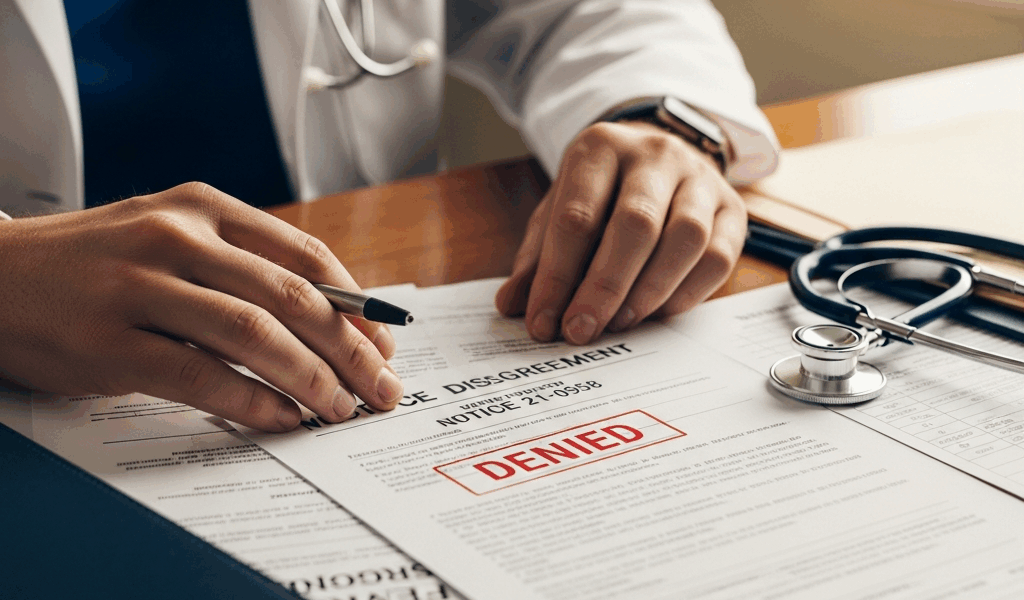
Why VA Denies Sleep Apnea Claims So Often
VA sleep apnea claims have gotten complicated with all the confusing denial language flying around. You open that letter expecting answers and instead get phrases like “insufficient evidence of service connection” or “no diagnosis during active duty.” I’ve reviewed hundreds of these decisions, and they almost always collapse into two problems: either the VA says there’s no in-service diagnosis, or they flat-out reject the connection to your military service.
Here’s what I want you to understand before anything else — neither denial means your claim is finished. Sleep apnea is notorious for showing up years after separation. You might have slept fine at 25, spent 14 months on a sand-choked FOB in Kandahar, and woke up at 35 unable to breathe right. The VA sees that gap and checks the denial box. That gap doesn’t erase the connection. It just means you have to prove it differently than you did the first time.
The denial is an invitation to build a better case. So, without further ado, let’s dive in.
Read Your Decision Letter Before You Do Anything Else
Probably should have opened with this section, honestly. Most veterans skip straight to filing an appeal without actually understanding why they lost. Don’t make my mistake — I once spent three months preparing the wrong type of appeal because I misread one paragraph in my denial letter. That’s a mistake that costs you time you can’t get back.
Your decision letter contains the exact language the VA used against you. Find it. Underline it. Look for these specific phrases:
- “No evidence of diagnosis in the service member’s military medical records” — The VA found no sleep apnea diagnosis while you were on active duty. It doesn’t mean you didn’t have it. It means there’s no paper trail connecting it.
- “Insufficient evidence to establish a nexus between service and current condition” — They acknowledge you have sleep apnea now. They just don’t see proof that service caused it.
- “Rating denial” — You got service connection, but you’re sitting at 0% instead of 50%. You won the argument; you lost the money.
- “Service connection denial” — You didn’t get service connection at all. This is the harder road, but it’s still a road.
The distinction matters enormously — a rating denial means you already have service connection in hand and you’re fighting for compensation. A service connection denial means you’re rebuilding the entire argument from scratch. Read the letter twice. Screenshot it. You’ll reference that exact language in every document you file going forward.
How to Build a Service Connection Argument That Holds
Frustrated by two straight denials, a veteran I’ll call Marcus — a former Army infantryman who did back-to-back deployments to Iraq — built a three-pronged nexus strategy using private medical records, a $450 specialist letter, and buddy statements from two guys in his old unit. The Board overturned his claim on the third try.
There are three main service connection pathways for sleep apnea. You don’t need all three. But stacking them makes your appeal significantly harder to dismiss.
Direct Service Connection
You served in a dusty, chemically compromised environment — Iraq, Afghanistan, Kuwait, the burn pit circuit — and your airway took damage. Military medical records showing upper respiratory problems, chronic sinusitis, or nasal polyps during service are gold here. Your nexus letter needs to say plainly: “It is more likely than not that the Veteran’s sleep apnea is causally related to [specific in-service event or exposure].”
What kills this path — and I’ve seen it kill otherwise strong claims — is a nexus letter that hedges. “May be related” or “could be associated” will get you denied again. The VA standard is “more likely than not,” meaning 50% confidence or better. Vague language fails every single time.
Secondary to a Rated Condition
But what is secondary service connection? In essence, it’s linking your sleep apnea to a condition the VA already accepted as service-connected. But it’s much more than that — it’s often the fastest win available to veterans who’ve been denied on direct service connection.
Do you have a rated condition? PTSD, sinusitis, nasal polyps, rhinitis, deviated septum, anxiety, depression — any of these can connect to sleep apnea. PTSD causes hyperarousal and sleep fragmentation that feeds directly into obstructive apnea. Sinusitis narrows airways physically. A nexus letter linking your sleep apnea to an already-rated condition is powerful because the VA already agreed that original condition came from service. You’re not starting a new fight. You’re extending one they already conceded.
A letter might read: “The Veteran’s service-connected PTSD causes hyperarousal and sleep fragmentation, which exacerbates obstructive sleep apnea.” That sentence, written by the right doctor on the right letterhead, has changed outcomes.
Aggravation
You had mild or undiagnosed sleep apnea before service. Military service made it measurably worse. Your nexus letter states: “The Veteran’s sleep apnea was aggravated by military service beyond its natural progression.” That framing matters legally — aggravation is a recognized pathway, and the VA is required to consider it.
Now, about the nexus letter itself. Hire a sleep medicine physician or a pulmonologist — not your primary care doctor. Specialist opinions carry weight that general practitioners simply don’t. The letter must be on official letterhead, include the doctor’s credentials, and address the specific denial language from your letter directly. Cost typically runs $300 to $600. Some VSOs offer free support, but a private independent letter is often stronger precisely because it’s independent of the VA system.
One more thing worth knowing: if the VA never ordered a sleep study, get one privately. A formal study showing moderate-to-severe obstructive sleep apnea gives you objective data the VA can’t dismiss as someone’s opinion. Yes, it costs $1,500 to $3,000 out-of-pocket depending on your area. I’m apparently someone who needed two of them before my own claim moved — and that second study at $1,800 broke a claim that had been stalled for 16 months. Use the results in your appeal package. Every page of it.
Which Appeal Lane to File and Why It Matters
You have three options under the Appeals Modernization Act. That’s what makes this system endearing to us veterans — three paths, each with different speeds, requirements, and outcomes. Choose the wrong one and you waste months of time and burn evidence you needed to save.
Supplemental Claim
File this if you have new evidence the VA never reviewed. New sleep study, new nexus letter, buddy statements, records your original rater never saw — anything genuinely new qualifies. This lane moves fast, often 3 to 4 months. A different rater reviews your file with fresh eyes. No hearing required. If they deny you again, you escalate to the Board from there.
Board with Direct Review
No new evidence. Same file, argued better. A panel of veterans law judges reads what you already submitted and decides based on that. Slower — often 1 to 2 years — but you’re not counting on new material to carry you. Only file this lane if you genuinely believe the original rater misread what was already in front of them.
Board with Hearing
You appear before a judge — by phone or video, you’re not flying to D.C. — and you testify. Your symptoms. Your service. Your specific exposures. The judge can ask follow-up questions. That humanizes the file in a way that paper never fully does. Takes 2 to 3 years. But if you’re articulate and your symptoms are documented and obvious, a hearing helps. I’m apparently someone who performs better in writing than in testimony, and I still found the hearing format worth it.
My recommendation: start with a Supplemental Claim, attach a new nexus letter, include every buddy statement you’ve gathered, and move fast. That’s the fastest path to a fresh look. If it fails, escalate to the Board and request a hearing.
Mistakes That Kill Sleep Apnea Appeals Before They Start
- Missing the one-year window. You have exactly one year from the date on your denial letter to file any appeal. Miss it and your effective date resets — or the claim closes entirely. Put that deadline in your phone right now. Non-negotiable.
- Filing the wrong lane. Don’t file a Board appeal when you have new evidence sitting on your desk. Don’t file a Supplemental Claim when you genuinely have nothing new to add. The lane determines speed, outcome, and what evidence you can use.
- Submitting a vague nexus letter. “May be related” fails. “Could contribute” fails. Your letter must say “more likely than not” and must cite specific service exposures, conditions, and dates. Anything softer than that gets checked into the denial pile.
- Ignoring the secondary connection. You already have a rated condition — PTSD, sinusitis, rhinitis, something. Sleep apnea can connect to it. Veterans leave real money on the table every year by arguing only direct service connection when a secondary pathway was sitting right there.
- Zero buddy statements. Your buddy served with you in 2004. He remembers you snoring through the walls of a CHU in Mosul. He knows what that base smelled like at 0300. A sworn buddy statement from someone who knew you during service is evidence the VA is required to consider — and most veterans never gather a single one.
Denials get overturned every day. That was true in 2015 and it’s true now. I’ve watched claims denied twice get approved on the third attempt — not because something magical happened, but because the veteran came back with a specialist letter, a sleep study, two buddy statements, and filed in the right lane. You’re not starting over. You’re starting better.



Leave a Reply