 Free PR TrackerMaxRepsLog deadlift, squat, bench, and accessory lifts in seconds. Built for service members training for the ACFT and tactical fitness standards.Download for iPhoneGet it on Google Play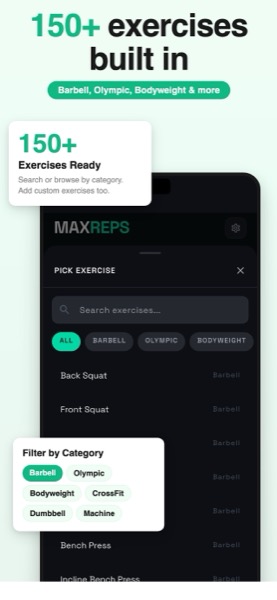
The 3-Repetition Maximum Deadlift event on the Army Combat Fitness Test rewards consistency over time. A soldier who walks into test day having lifted heavy twice a week for three months performs differently than one who hits the gym sporadically and hopes muscle memory carries them through. The harder problem isn’t training — it’s tracking. Knowing your last six weeks of deadlift progression, your best estimated 1RM, and how your lifts compare to scoring thresholds is the difference between targeted training and guessing.
MaxReps is a PR (personal record) tracker designed for this exact problem. After a few months of using it during ACFT-prep cycles, here’s the field assessment for service members managing tactical fitness training.
The ACFT Deadlift Standards in 2026
The 3-Rep Max Deadlift is scored on age and sex bands. Recent updates to the test have refined the scoring slightly, but the core ranges:
- Minimum (60 points) for most age/sex bands: 140-200 lbs
- Average (70-80 points): 200-260 lbs
- Excellent (90 points): 260-310 lbs
- Maximum (100 points): 340 lbs (most bands)
For most service members, the gap between “passing” and “scoring well” comes down to deadlift progression. A soldier at 180 lbs deadlift hits passing; the same soldier at 240 lbs scores 70-80; at 280-300 lbs they’re in the 90s. Each 20-pound increase in 1RM equates to roughly 5-8 ACFT points.
Tracking the Right Numbers
Three numbers matter for ACFT deadlift prep:
1. Estimated 1-Rep Max (1RM). Even if you train at 75% of max for sets of 5, knowing your projected 1RM tells you where your ceiling is. Common formulas (Epley, Brzycki) derive 1RM from weight × reps. MaxReps calculates this automatically when you log a working set.
2. 3RM tested value. The actual ACFT test is 3 reps. Train this specifically — usually a few weeks before the test, peak at a 3-rep set with the heaviest weight you can perform with form. This is your test-day predictor.
3. Volume per week. Total weight lifted in the deadlift across all working sets per week. A soldier consistently moving 12,000-18,000 lbs of deadlift weekly will progress faster than one doing 6,000-8,000 lbs.
Tracking these by memory or paper journal works for one or two cycles, then gets messy. An app that captures the data with one tap per set keeps the long-term record clean.
What MaxReps Does
The app’s core workflow:
- Pick the exercise (deadlift, squat, bench press, overhead press, plus accessories)
- Tap to log each set with weight and reps
- App computes estimated 1RM from each set
- View progression chart over time (week-over-week, month-over-month)
The progression chart is the killer feature for ACFT prep. You can see whether your 1RM is trending up, flat, or down across the training cycle. A 6-week chart showing 1RM growing from 280 to 310 confirms the program is working. A chart that’s been flat for 4 weeks signals the need for a programming change.
Where It Fits in an ACFT Prep Cycle
For a 12-week ACFT prep cycle:
Weeks 1-4 (Volume Phase): Multiple sets of 5-8 reps at 65-75% of estimated 1RM. Use MaxReps to log every working set; the 1RM estimate updates with each session.
Weeks 5-8 (Strength Phase): Sets of 3-5 reps at 80-90% 1RM. The strength phase is where 1RM growth happens. Track every session — if 1RM estimate stalls for 2 consecutive weeks, deload or change programming.
Weeks 9-11 (Peak Phase): Sets of 1-3 reps at 90-100% 1RM. Approaching test conditions. The 3RM at this phase is your test-day predictor.
Week 12 (Taper): Light volume, full recovery. Don’t train heavy in the 4-5 days before the test.
Each phase generates 2-3 logged sessions per week of deadlift specifically. By test day, you have 24-36 deadlift sessions logged with progression data. This dataset informs whether the training worked and how to design the next cycle.
Beyond Deadlift — The Full ACFT Picture
MaxReps supports the other ACFT-relevant lifts:
Squats — direct carryover to deadlift strength and to the Standing Power Throw event (which rewards hip and posterior chain power).
Bench press — proxy for upper-body pressing strength, which carries to push-ups and to general tactical fitness.
Overhead press — shoulder stability and pressing strength.
Rows and accessories — bilateral upper-back work supporting deadlift form and helping prevent lower-back fatigue during the 3RM attempt.
Tracking all four primary lifts plus accessories gives you the complete picture of where strength is developing and where plateaus are forming.
For Officers and NCOs Programming Squad Fitness
If you’re responsible for unit fitness programming, the MaxReps approach has value beyond individual tracking. Several squad leaders I’ve talked to use the app for their own training and recommend it to soldiers who ask. The pattern: lead by example, share progression charts, normalize the data-driven approach to fitness.
The alternative (paper journal, mental tracking, or no tracking) leaves training to chance. With consistent data, soldiers can identify what works for their body — some respond to volume, some to intensity, some to frequency variation. Without data, programming is guess-and-check.
Limitations
Honest assessment:
Doesn’t replace a programming book. MaxReps tracks your data; it doesn’t tell you how to structure the program. For programming, use proven templates (5/3/1, Starting Strength, Conjugate, ACFT-specific blocks from Stew Smith or Athlean-X). MaxReps is the spreadsheet, not the coach.
Doesn’t capture form quality. A 320-lb deadlift with rounded back is worse than a 280-lb deadlift with neutral spine. The app logs weight, not form. Pair with video review or in-person coaching.
Won’t fix recovery gaps. If you’re sleeping 5 hours, eating poorly, and training heavy, the chart will show stagnation regardless of programming. Tracking reveals the gap; it doesn’t close it.
Compared to Generic Workout Apps
Several generic strength-training apps exist (Strong, Hevy, Strava for lifting). MaxReps‘ specific advantages for tactical fitness:
- Faster logging — fewer taps per set, no advertisement layer
- Focused on the lifts that matter for tactical fitness rather than bodybuilding or powerlifting-specific programs
- Clean progression visualization without subscription paywalls
- No social-media gamification — built for personal tracking, not sharing
For service members who want a tool, not a community, the simpler interface wins.
PR TRACKER APPMaxRepsStart tracking your deadlift PR this weekDownload for iPhoneGet it on Google PlayThe Two-Cycle Test
The recommendation for any service member: track two consecutive ACFT prep cycles (24 weeks). At the end of cycle 2, compare:
- Cycle 1 starting 1RM vs ending 1RM
- Cycle 2 starting 1RM vs ending 1RM
- What programming changes between cycles, and what impact each change had
Most soldiers find one programming style or rep range that produces noticeably better progression for their body. The data-driven comparison is impossible without consistent tracking.
For service members reading this who haven’t been tracking, start this week. Log every working set for 30 days. The pattern that emerges will tell you more about your training than any general advice can.
Free Strength TrackerMaxRepsOne-tap logging, automatic 1RM estimation, clean progression charts. Built for service members training for ACFT and tactical fitness standards.Download for iPhoneGet it on Google Play


Leave a Reply