 Free Calculator + CoachAFT ProAFT Pro— Army Fitness Test CalculatorDownload for iPhoneGet it on Google Play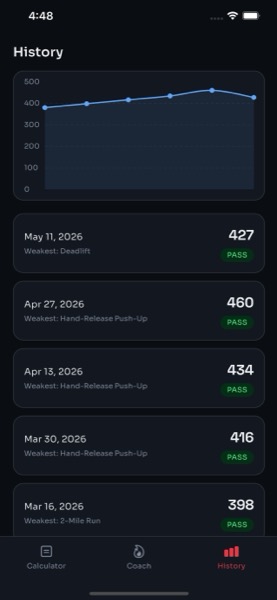
The Army Combat Fitness Test rewards preparation more than raw athleticism. A soldier who walks into test day knowing every event’s scoring threshold, who’s tracked their training numbers for 12 weeks, and who has projected their score using a calculator tends to outperform stronger soldiers who didn’t bother with the math. The events themselves are designed to test combat readiness across strength, endurance, and movement quality. The scoring system is designed to be precise — and once you understand it, the test becomes a number you can manage rather than a fitness mystery.
Here’s the 2026 scoring breakdown event by event, with training implications for the next test cycle.
The Six ACFT Events
The 2026 Army Combat Fitness Test consists of six events scored 0-100 each, with a passing minimum on each and a combined score requirement.
1. 3-Repetition Maximum Deadlift (MDL). Tests lower-body and grip strength. Score range from 60 (minimum) to 100 (maximum). Performance varies meaningfully by age/sex band — the 100-point threshold for a 20-29 male is around 340 lbs; for a 40-49 male, around 290 lbs.
2. Standing Power Throw (SPT). Backward overhead throw of a 10-lb medicine ball measuring explosive power. Distance translates to score on a curve. The 100-point threshold for most age bands sits around 12.5 meters.
3. Hand-Release Push-Ups with Arm Extension (HRP). Modified push-up with chest contact and arm extension at the bottom. Max score around 60 reps for younger age bands, scaling down for older soldiers.
4. Sprint-Drag-Carry (SDC). Five-leg event combining sprint, sled drag, lateral movement, carry, and sprint. Scored by completion time. Max score around 1:33-1:40 depending on band.
5. Plank (PLK). Replaced the leg tuck. Hold time measured. Max score around 3:30-4:00. Tests core endurance.
6. Two-Mile Run (2MR). Final event, tests aerobic capacity. Max score around 12:30-13:00 for younger bands, scaling.
The Scoring Math
Each event scores 0-100 against age/sex performance tables. Combined score requirement is 360 points (60 minimum per event × 6 events) for most MOS categories. Higher MOS categories (Special Forces, Rangers, Air Assault, Airborne) have higher minimum requirements per event.
The math implication: maximizing your score isn’t about being elite at one event. It’s about hitting strong scores across all six. A soldier scoring 100/100/80/80/80/80 (520 total) outscores another at 100/100/100/60/60/60 (480 total) despite the second having more perfect events.
Distribution matters. Most soldiers who fail the ACFT fail because they’re weak on a specific event (often plank or 2MR) while strong elsewhere. Identify your weakest event and train it harder.
2026 Updates to Watch
The ACFT in 2026 reflects several years of refinement since its initial rollout:
- Plank replaced the leg tuck several years ago and remains the alternate-core event
- Hand-release push-up replaced the standard push-up
- Sprint-drag-carry retains its 5-leg structure
- Standing power throw scoring has been calibrated against year-over-year score distributions
The test is well-established. Soldiers training for the 2026 cycle work against scoring tables that have been stable for several test cycles.
Tracking Training Through a Prep Cycle
For a 12-week ACFT prep cycle, training breaks down roughly:
Weeks 1-4 — Volume foundation. Higher-rep work on the strength events (deadlift, push-up). Build base aerobic capacity for the 2MR. Plank holds at submaximal duration.
Weeks 5-8 — Strength phase. Heavier deadlift work in the 3-5 rep range. Push-up volume progression. SDC pace work. Power throw technique refinement.
Weeks 9-11 — Specificity peak. Mock ACFT every 2-3 weeks. Score yourself on each event. Identify and address weak events.
Week 12 — Taper. Reduced volume, full recovery. No new max attempts in the 4-5 days before the test.
Tracking progression through this cycle requires consistent logging — every working set on strength events, every mock test, every 2MR practice run. By the test, you should have a 12-week data set predicting your test-day performance within a few points per event.
ARMY FITNESS APPAFT ProTrack every event through prep + test dayDownload for iPhoneGet it on Google PlayEvent-Specific Training Notes
Deadlift. The single most important strength event. A 60-point increase in deadlift score (going from 220 lbs to 300 lbs MDL) is worth meaningfully more than improving any other event. Train this 2-3x per week with progressive overload. Common mistake: training only at percentages and never testing — you should periodically test 1RM or 3RM to know where you actually stand.
Standing Power Throw. Technique matters more than raw strength. Practice the throw motion specifically. Most soldiers can add 1-2 meters with technique work alone. Hip drive, full extension, release angle around 45 degrees.
Hand-Release Push-Ups. Volume training. Submaximal sets multiple times per day. Greasing-the-groove method (sets of 5-10 throughout the day) works well. Watch the hand-release form — chest must touch, arms extend fully at the bottom. Failing forms cost reps.
Sprint-Drag-Carry. Sport-specific drilling. The transitions between sub-events cost the most time. Practice the full SDC sequence on a measured course at least once per week in the final 6 weeks.
Plank. Most soldiers improve plank dramatically with focused training. Daily holds, progressive duration. Form matters — straight line from heels to head, no sagging or piking. A poorly-held plank doesn’t count toward score even if the timer runs.
Two-Mile Run. The last event when you’re most fatigued. Train for fatigued running specifically. Brick workouts combining a strength workout followed by the 2MR simulate test-day conditions.
Age/Sex Banding
The ACFT scoring tables adjust for age and sex. Younger soldiers face higher thresholds for the same score; older soldiers receive proportionally easier thresholds.
Example for deadlift 60-point passing threshold:
- Male 17-21: 140 lbs
- Male 27-31: 140 lbs (typical baseline range)
- Male 42-46: 140 lbs (similar)
- Male 57+: 130 lbs
- Female 17-21: 120 lbs
- Female 27-31: 120 lbs
- Female 42-46: 110 lbs
The 100-point threshold differs more meaningfully:
- Male 17-21: 340 lbs
- Male 27-31: 340 lbs
- Male 42-46: 290 lbs
- Male 57+: 270 lbs
Plan your training against your specific age band’s tables. The numbers that move scores are different at 22 vs 42.
Retake Rules and Consequences
Failing the ACFT — either failing an individual event or falling below combined minimum — triggers specific consequences depending on the soldier’s career situation:
- First-time failure on a record ACFT: retest within 90 days, possibly assigned to remedial PT
- Repeated failures: can lead to bar to reenlistment, flag to performance, possible separation
- Initial Entry Training: ACFT failure can delay or prevent graduation
- Promotion qualification: ACFT score affects promotion points
- Schools and qualifications: many courses require minimum ACFT scores
The stakes are real. A soldier who failed the ACFT and didn’t take training seriously between attempts has a measurably different career trajectory than one who treated the prep cycle as the work it requires.
MOS-Specific Higher Standards
Combat Arms MOSs and special operations communities require higher ACFT scores than the standard 360 minimum:
- Most Combat Arms: 70 minimum per event, 420 combined typical floor
- Special Forces Assessment and Selection (SFAS): higher score requirements
- Ranger Assessment and Selection Program (RASP): elevated standards
- Sapper School, Air Assault, Airborne: school-specific minimums
Soldiers in these communities should train to substantially exceed the 360 minimum. A combat infantry sergeant at 360 ACFT is meeting absolute minimum; the soldiers around them are pulling 500+.
What to Do This Week If You Have an ACFT Coming Up
For a record ACFT in 12 weeks:
1. Test your baseline today. Run a mock ACFT or estimate scores based on recent training. Know where you start.
2. Identify your weakest event. The score you want to improve most is your lowest event, not your strongest. Add 1-2 extra training sessions per week focused on that event.
3. Schedule mock ACFTs at weeks 6 and 10. These calibrate where you are and where you need to focus the final weeks.
4. Track every training session. Without data, you’re guessing. With data, you can see whether the program is working.
5. Plan the taper. Reduce volume in week 12. Most soldiers underperform by training too hard in the days before the test.
ARMY FITNESS APPAFT ProFree. 2026 scoring tables. Age/sex banded. Project your total and track every event.Download for iPhoneGet it on Google Play


Leave a Reply