 Field Recipe BuilderMRE ProMRE menu ratings, custom recipe combinations, and the field hacks experienced service members use to upgrade baseline rations.Download for iPhoneGet it on Google Play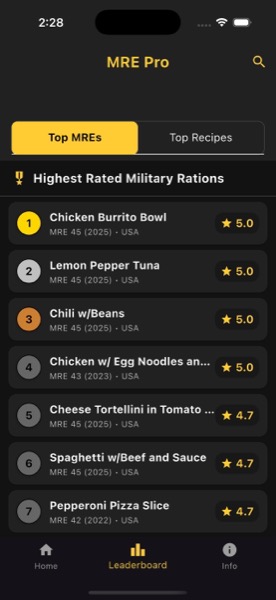
Meals Ready-to-Eat have been the standard field ration for the US military since the early 1980s, and the menu has expanded considerably from those early days. The current menu rotation includes around 24 main course options across breakfast and dinner, with components for cold weather, hot weather, vegetarian, kosher, and halal variants. The unspoken truth among service members: some menus are genuinely good, others are tolerable, and a couple should be left for someone else. The ranking shifts with each MRE generation update, but the cultural memory persists.
For service members new to field rations, or those looking to upgrade their MRE experience with combined-component recipes, here’s the practical field guide.
The Current MRE Menu
The 2026 menu rotation includes (with field reputation in parentheses):
- Menu 1 — Chili with Beans (solid mid-tier)
- Menu 2 — Shredded Beef in Barbecue Sauce (well-liked)
- Menu 3 — Chicken, Egg Noodles, and Vegetables in Sauce (varies)
- Menu 4 — Spaghetti with Meat Sauce (legendary status)
- Menu 5 — Chicken Chunks (basic, useful for combining)
- Menu 6 — Beef Taco (cult favorite)
- Menu 7 — Beef Brisket (well-liked)
- Menu 8 — Meatballs in Marinara Sauce (solid)
- Menu 9 — Beef Stew (acceptable)
- Menu 10 — Chili with Macaroni (mid-tier)
- Menu 11 — Vegetable Crumbles with Pasta in Taco Sauce (vegetarian, divisive)
- Menu 12 — Elbow Macaroni in Tomato Sauce (light)
- Menu 13 — Cheese Tortellini (vegetarian, well-liked)
- Menu 14 — Pepperoni Pizza Slice (newer, well-received)
- Menu 15 — Beef Roast (varies)
- Menu 16 — Beef Patty, Grilled, Jalapeno Pepper Jack (solid)
- Menu 17 — Asian Beef Strips with Vegetables (varies)
- Menu 18 — Chicken with Egg Noodles (basic)
- Menu 19 — Lemon Pepper Tuna (cold-eat option)
- Menu 20 — Spinach Mushroom Fettuccini (vegetarian)
- Menu 21 — Hash Browns with Bacon, Peppers (breakfast)
- Menu 22 — Asian Style Beef with Vegetables (varies)
- Menu 23 — Cheese Tortellini in Tomato Sauce (vegetarian)
- Menu 24 — Pepperoni Pasta in Tomato Sauce (newer)
Menu numbering and contents shift over the years as Combat Feeding Directorate updates the lineup. Current menus reflect 2020s-era improvements that have generally moved the experience upward.
The “Good” MRE Tier — What Experienced Service Members Reach For
Some menus consistently rank near the top across rotations:
Menu 4 — Spaghetti with Meat Sauce. The legendary high-tier MRE. Substantial meat sauce, solid pasta, well-received across nearly all service members. Often traded for as a premium item.
Menu 6 — Beef Taco. Cult favorite. The taco filling combined with the included tortilla and accessory pack creates an actual taco experience. Frequently the first menu reached for in a case.
Menu 7 — Beef Brisket. Real meat texture, solid sauce, substantial. One of the rare MREs that actually tastes like the named dish.
Menu 14 — Pepperoni Pizza Slice. Newer addition. A real pizza slice, not just a description. Well-received.
Menu 8 — Meatballs in Marinara. Solid Italian-style. The meatballs and sauce go well over the included pasta or rice.
The “Tolerable” Mid Tier
Most MREs fall into the mid-tier — not first picks, but acceptable. Menus 1, 9, 10, 15, 17, 18, 22 typically sit here. They’re nutritionally complete, taste OK, and don’t disappoint. Just not the menus you reach for first.
The “Bottom Tier” — Trade Bait
Some menus consistently rank lower across rotations:
Menu 5 — Chicken Chunks. Bland chicken in mild sauce. Most service members consider this trade bait — useful for combining (the chicken can be added to other menus) but unappetizing standalone.
Menu 11 — Vegetable Crumbles with Pasta. Vegetarian menu that polarizes. Some service members like it; others avoid.
Menu 20 — Spinach Mushroom Fettuccini. Another vegetarian option. Reception varies.
For service members who don’t eat vegetarian: the vegetarian menus are often traded away. For those who do eat vegetarian, the same menus might be top picks.
Combining Components — The Real MRE Skill
Experienced service members rarely eat MREs as packaged. The accessory pack (peanut butter, jelly, crackers, cheese spread, hot sauce, chocolate) combined with main course components creates better meals than any individual MRE.
Classic combinations:
“Ranger Pudding” — combine the cocoa powder packet from the beverage accessory with the creamer, water, and sometimes peanut butter. Stir to consistency. A field dessert with substantial calories.
Chili-Mac Upgrade — combine Menu 1 (chili) with Menu 12 (elbow macaroni) and the cheese spread accessory. Creates a hearty single-pot meal from two basic menus.
Pizza Build — combine Menu 14 (pizza slice) with extra cheese from another menu’s accessory pack and the included hot sauce. Approximates an actual pizza experience.
Field Tacos — Menu 6 taco filling plus tortilla, plus cheese spread, plus hot sauce, plus the dried chips that appear in some menus. Better than any single component.
Breakfast Burrito — Menu 21 (hash browns with bacon) combined with a tortilla from another menu and the cheese spread. Reasonable breakfast burrito.
Peanut Butter and Jelly Crackers — combine accessory crackers with the peanut butter and jelly packets. A standby that experienced soldiers carry in pockets for low-energy moments.
Field Hacks That Improve Any MRE
Beyond combining specific menus:
Use the flameless ration heater (FRH) effectively. The MRE heater works best with the entrée pouch inserted properly, water at the right amount (a few ounces), and 10-12 minutes of heating time. Rushing the FRH produces partially-heated meals.
Hot sauce on everything. Tabasco mini-bottles in the accessory pack are universally improvement. Even the menus that don’t seem to need it benefit from a few drops.
Cheese spread as binding agent. The processed cheese spread in many menus works as a binder, sauce enhancer, or eaten directly with crackers. Surprisingly versatile.
Save the candy and gum for moments of need. The included candy (M&Ms, hard candy) and gum provide a meaningful morale boost during long field exercises. Don’t blow through them in the first day of an extended op.
Coffee accessory pack. Many menus include instant coffee and sugar. The coffee is functional, not great. Some service members carry their own instant coffee replacement (Starbucks Via or similar) for better field coffee.
MRE RECIPE APPMRE ProMRE Proincludes menu-by-menu ratings, accessory pack contents, and a custom recipe builder for combining components. Useful for new soldiers and field-experienced veterans alike.Download for iPhoneGet it on Google PlayNutritional Reality of MREs
Each MRE provides approximately 1,200-1,300 calories with about 40-45% from carbohydrates, 35-40% from fat, and 15-20% from protein. Designed for a single soldier consuming three per day in continuous field operations, delivering roughly 3,600-3,900 daily calories — enough for sustained operations including cold weather and heavy load conditions.
The calorie density is intentional: MREs are designed for service members burning 4,000+ calories per day in field operations. Eating three MREs per day in garrison (without the corresponding activity level) will result in weight gain.
Sodium content is high — typically 1,000-1,500 mg per meal, or 3,000-4,500 mg per day with three meals. Designed to replace electrolytes lost through sweat during sustained activity. Civilians or service members in low-activity garrison shouldn’t eat MREs as a regular diet for this reason.
Storage and Shelf Life
MREs have impressive shelf life if stored properly:
- Manufacturer rating: 3 years at 80°F
- Practical performance: 5-7 years stored at room temperature
- Higher temperatures shorten shelf life (90+°F reduces palatability quickly)
- Freezing degrades texture but doesn’t make MREs unsafe
For service members building personal field stockpiles or preppers, MREs offer a known-good emergency food option. Cycle through and replace every 3-5 years for best quality.
The MRE Community Beyond Active Duty
The MRE has developed a substantial civilian collector and enthusiast community. YouTube channels dedicated to MRE reviews (Steve1989MREInfo most prominent) have millions of views. The military culture around field rations has spilled into mainstream awareness.
For active and former service members, this provides:
- External context for the rations you’ve eaten for years
- Historical knowledge about MRE evolution since 1981
- Comparison with foreign military rations (the IMP, RCIR, EPA, and others)
- Community of fellow ration enthusiasts
The cultural side of MREs has become a small genre of its own. Worth engaging with for the historical context if you’re interested.
For New Service Members
Three tips for soldiers eating MREs for the first time:
1. Sample before committing. If your unit issues an MRE case, find someone experienced and ask which menus to grab and which to leave. The reputation rankings are surprisingly consistent across years and units.
2. Combine, don’t just eat. The accessory pack contents are designed to be combined. Eating components separately as packaged is the rookie approach. Experienced soldiers create combinations.
3. Pace yourself on the candy and morale items. The MRE’s secondary purpose is morale. Use the candy, gum, and dessert items strategically during long field operations rather than burning through them at first opportunity.
MRE RECIPE APPMRE ProMRE Pro— Menu Ratings + Recipe BuilderDownload for iPhoneGet it on Google Play



Leave a Reply