2026 Tattoo Policy by Branch at a Glance
The table below gives you the quick reference you need. Read the sections underneath it for the nuances — the table alone won’t cover everything that matters to your specific situation.
| Branch | Allowed Locations | Size/Coverage Limits | Hard Bans |
|---|---|---|---|
| Army | Arms, legs, torso, one hand tattoo permitted, one ring tattoo per hand, small neck tattoo (below collar) | No size cap on arms/legs; neck tattoo must be 1 inch or smaller | Face, head, extremist/racist/sexist content |
| Navy | Full sleeves allowed, neck tattoos allowed, one hand tattoo per hand, behind-the-ear tattoos (single, small) | No size restrictions on most areas since 2016 update, sustained through 2026 | Face, scalp, inside mouth, prohibitive content |
| Air Force | Arms, legs, torso; tattoos visible in PT gear reviewed case by case; single finger/hand tattoos allowed | Must not exceed 25% of exposed body part; reviewed by commander | Face, neck (above collar), offensive content |
| Marines | Arms and legs below elbow/knee; band tattoos on wrist allowed | No single tattoo larger than the wearer’s hand; no sleeves | Face, neck, hands (beyond wrist band), elbows, knees, offensive content |
| Coast Guard | Arms, legs, torso; single tattoo on hand allowed; neck tattoos on case-by-case basis | Must not be visible above collar in uniform; commander approval required for borderline cases | Face, scalp, prohibited content, anything deemed unprofessional by CO |
| Space Force | Follows Air Force policy as baseline; neck tattoos reviewed by unit commander | 25% rule applied to exposed body parts; some flexibility based on role/assignment | Face, offensive content; policy still maturing as of 2026 |
That’s the skeleton. Now let’s get into what actually shifted and why it matters to you specifically.
What Changed Recently
Frustrated by losing otherwise qualified recruits over tattoo disqualifications, the Army made the most headline-grabbing move in 2022 — they officially opened the door to hand and neck tattoos for the first time in the modern era. One tattoo per hand, nothing exceeding one inch. A ring tattoo on one finger per hand. A single tattoo on the back of the neck, staying under one inch. That came straight out of updated Army Regulation 670-1 — not a rumor, not a recruiter’s interpretation. An actual policy shift.
The Navy had already been drifting permissive since 2016, and 2026 finds them firmly settled there. Full sleeve tattoos are allowed. Neck tattoos are allowed — provided they stay off the face and scalp. They even permit a single small tattoo behind each ear. Honestly, the Navy is the most tattoo-friendly branch by a wide margin right now. That’s what makes their policy endearing to us heavily-tattooed folks who still want to serve.
The Air Force kept location policies relatively stable but leaned harder into content standards — and, more importantly, commander discretion. Their 25% rule is still the main benchmark: a tattoo can’t cover more than a quarter of any exposed body part during uniform or PT wear. But the bigger story is how much authority unit commanders now carry in flagging tattoos as problematic even when they don’t technically break a specific rule. Stationed under a strict commander? Your borderline forearm piece might suddenly become a documented problem. That inconsistency is real.
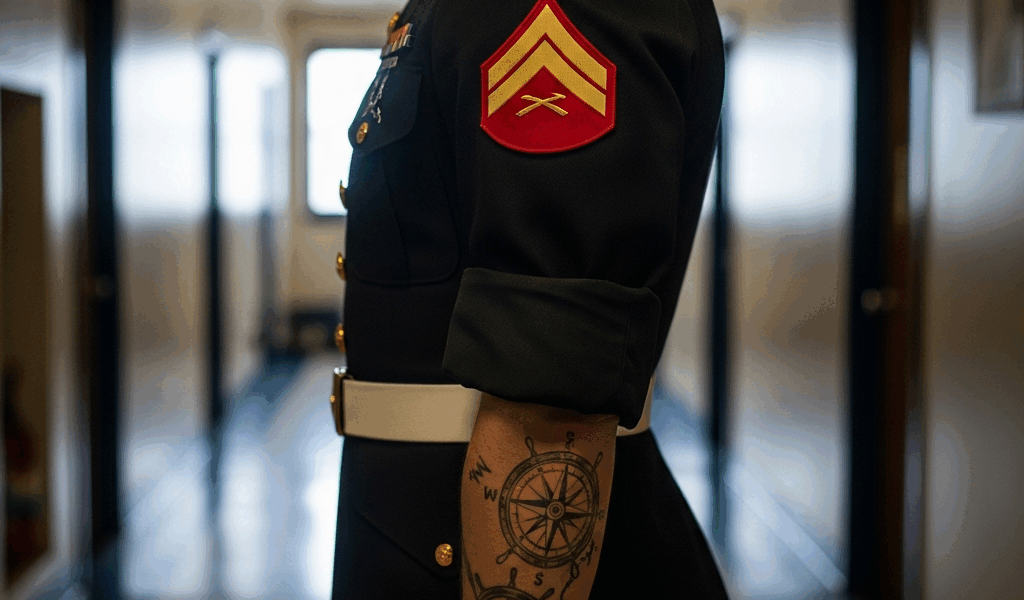
The Marines remain the most restrictive branch. Full stop. They updated policy to allow narrow wrist-band style tattoos — that’s about as permissive as they’ve gotten. No sleeves. No elbow or knee tattoos. No hand tattoos beyond that narrow wrist-band exception. The size cap holds: nothing bigger than the wearer’s own hand. If you’re heavily tattooed and set on becoming a Marine, have that honest conversation with a recruiter early — before you invest months in the process.
Space Force is the wildcard. Launched in 2019, they’ve been running on Air Force regulations as a default ever since. As of 2026, they’re still refining their own identity — tattoo policy included. Assume Air Force rules apply unless a Space Force recruiter or gaining unit tells you otherwise in writing.
Tattoos That Will Still Get You Disqualified
Face tattoos. All six branches ban them. No exceptions. No waivers in standard processing. Forehead, cheeks, chin, around the eyes, on the nose — any of it, and you’re not eligible under any current 2026 policy. That’s a hard wall, and it’s not moving.
Beyond location, the content of your ink matters just as much. Every branch maintains prohibitions against:
- Extremist or supremacist imagery — symbols tied to white nationalism, gang affiliation, or any ideology that conflicts with the oath of service
- Obscene content — sexually explicit or pornographic imagery
- Discriminatory tattoos — anything demeaning people based on race, gender, religion, national origin, or sexual orientation
- Drug-related imagery — tattoos that glorify or depict illegal drug use
Recruiter discretion cuts both ways — don’t forget that. A recruiter who’s invested in you may work hard to document a borderline tattoo in the least problematic light. One who sees something they don’t like has full authority to flag it and push the decision upward. I’ve heard from people who passed with tattoos that others got rejected for — same ink, different human interpreting the rulebook. Document everything in writing. A verbal “that’ll be fine” means nothing at MEPS.
Scalp tattoos are universally banned. Behind-the-ear tattoos are branch-specific — the Navy allows them in limited form, most others don’t. Inside-the-mouth tattoos — and yes, this apparently comes up enough to be explicitly addressed — are banned everywhere.
Getting a Waiver for Existing Tattoos
Frustrated by the process after a recruiter flagged his forearm piece as borderline, one applicant I spoke with spent six weeks pulling together documentation before finally getting approved — photographs, a written statement from his tattoo artist explaining the design’s nautical symbolism, and a signed letter from his pastor in Fayetteville. That’s not typical. But it shows what the process can actually look like when it gets complicated.
Here’s how waivers work in practice.
The Army Waiver Process
Army tattoo waivers are handled at the battalion commander level for most cases. Get flagged at MEPS and your recruiter submits documentation to the battalion — expect 30 to 60 days of processing. You’ll need clear photographs of the tattoo, a written explanation of its meaning, and sometimes a dermatologist statement if removal has been raised as a question. Content waivers for clearly extremist or offensive imagery? Success rates are low. Don’t go in optimistic about those.
The Navy Waiver Process
The Navy allows so much that their waiver situations almost always involve content rather than location. Applications route through the Navy Recruiting Command. Same documentation requirements apply — photos, written explanation, supporting context. The Navy has a reputation for moving relatively fast on these, often inside 30 days.
The Air Force and Space Force Waiver Process
Air Force waivers go through the Medical Standards branch and sometimes require commander endorsement on top of that. The 25% rule generates most of the waiver situations — a large upper-arm tattoo that technically covers more than a quarter of visible skin in PT gear, for example. Get a measuring tape. Photograph it. Measure both the tattoo and the body part it sits on. The documentation needs to be precise, not approximate.
The Marines — Waiver Reality
Marine Corps tattoo waivers are processed at the recruiting command level, and their standards going in are stricter than any other branch. They are not sitting there looking for reasons to approve marginal cases. Location-based waivers — hands, neck, large upper-arm coverage — are rarely approved. Content-based waivers for genuinely borderline imagery have a slightly better track record, but only slightly. Go in clear-eyed about those odds.
What to Bring to Any Waiver Appointment
- High-resolution, well-lit photographs from multiple angles — not phone snapshots taken in bad lighting
- Measurements in inches for both the tattoo and the body part it covers
- A written personal statement covering the meaning and context
- Artist documentation if there’s a specific cultural or artistic context to establish
- Evidence of strong standing in other areas — recruiters weigh the whole picture, not just the ink
Don’t make my mistake — or the mistake I’ve watched a lot of other people make, anyway. A verbal okay from a recruiter at the first meeting is not clearance. The official documentation review happens at MEPS, and MEPS officers make their own independent assessments. Get everything confirmed in writing at every stage. That’s not paranoia. That’s how you protect yourself when the same regulation gets read six different ways by six different people at six different stations.
The bottom line heading into 2026: military tattoo policy has genuinely loosened in several branches — the Navy and Army most visibly. But the absolute lines around face tattoos, extremist content, and obscene imagery haven’t budged. Know your target branch, pull the actual regulation document yourself (Army AR 670-1, Navy MILPERSMAN 1900-020, USMC MCO 1020.34H), and walk into your recruiter meeting with documentation already in hand. Don’t wait for someone to tell you it’s a problem.




Leave a Reply