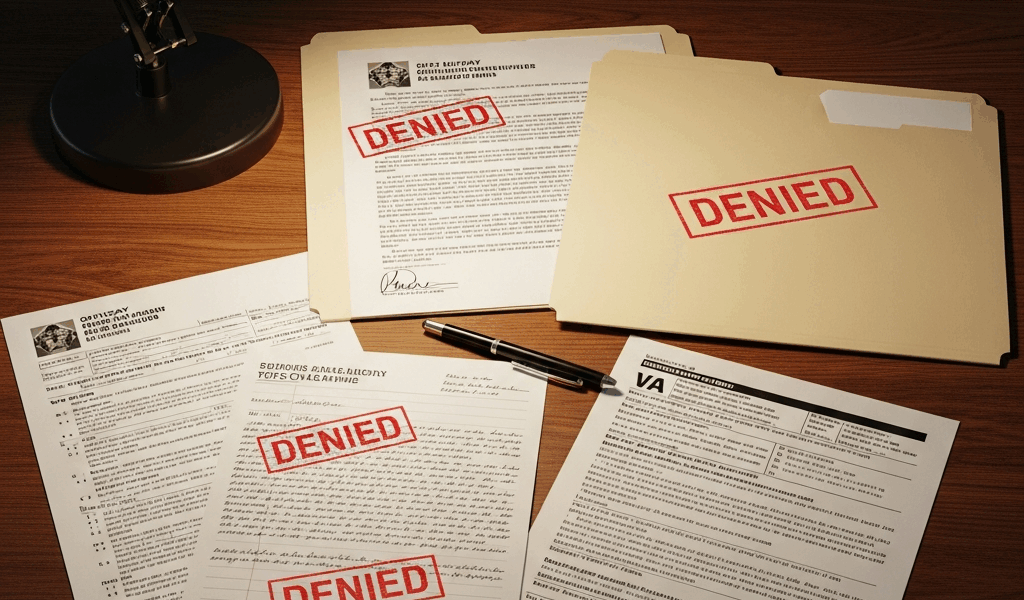
Why VA Denies PTSD Claims More Than Almost Any Other
VA PTSD claims have gotten complicated with all the misinformation flying around about what the VA actually looks for — and what kills your case before it even starts. I’ve worked with dozens of vets who’ve gotten that envelope, opened it at the kitchen table, and felt their stomach drop. The VA denies PTSD claims at a significantly higher rate than physical injuries. We’re talking somewhere around 60% on first submission, compared to 20-30% for conditions like tinnitus or knee surgery complications.
Three main reasons drive almost every denial. Lack of nexus — meaning the VA agrees you have PTSD but won’t connect it to your service. Failure to establish the in-service stressor event itself. Or no current diagnosis, usually because the VA’s C&P exam didn’t confirm your condition meets DSM-5 criteria.
Each denial reason requires a completely different fix. Probably should have opened with this section, honestly. Most veterans file appeals without knowing which category their denial falls into. That’s why they lose.
Read Your Decision Letter Before You Do Anything Else
The VA’s rating decision is dense, jargon-heavy, and deliberately exhausting to read. But buried inside is the specific reason your claim failed. Find the “Reasons and Bases” section — usually pages 2-4 of a standard decision letter. That section tells you exactly what the VA found and what it didn’t.
Look for these exact phrases:
- “We found no credible supporting evidence…” — Nexus denial. The VA believes your stressor happened and you have PTSD but won’t connect the dots.
- “The evidence does not support that you experienced the claimed stressor…” — Stressor denial. They’re saying your in-service event either didn’t happen or you can’t prove it did.
- “The reported symptoms do not rise to the level required for a PTSD rating…” — Diagnosis denial. The C&P examiner said your condition doesn’t meet DSM-5 criteria.
The difference matters enormously. A nexus fix requires a mental health professional. A stressor fix requires buddy statements and service records. A diagnosis fix requires either a better C&P exam or an independent evaluation that directly contradicts the VA’s findings.
You have exactly one year from the decision date to appeal. After that, you lose your right to challenge it without filing a completely new claim. Check the letter’s date right now. If you’re reading this and that date was more than 11 months ago, call a veterans law firm today — not tomorrow.
How to Fix a Nexus Denial for PTSD
But what is a nexus letter? In essence, it’s a one-to-three-page statement from a licensed psychologist or psychiatrist explaining why your military service caused your PTSD. But it’s much more than that — it’s a legal opinion based on your medical history, not just a clinical summary.
The VA’s own examiners often write weak nexus opinions. Something like: “The veteran reports combat exposure, and PTSD can result from combat, therefore a nexus is possible.” Possible is not good enough. The VA will cite that same vague language as justification to deny you.
A strong nexus letter reads completely differently. Here’s the language that actually moves the needle:
“Based on my clinical evaluation of [Veteran’s Name], review of the service records showing [specific incident], and the diagnostic criteria in the DSM-5, it is my opinion, within a reasonable degree of medical probability, that [Veteran’s Name]’s current PTSD diagnosis is causally related to the in-service stressor event of [specific stressor]. The medical literature supports that individuals exposed to [type of event] have documented increased risk of developing PTSD, and this veteran’s symptom presentation, trauma history, and clinical course are entirely consistent with service-connected PTSD.”
Notice the specifics: the veteran’s name, the actual incident, the DSM-5 reference, the word “probability” instead of “possible.” That’s what separates an approval from another denial letter.
Getting this letter costs real money. Private psychologists typically charge $400-800 for a nexus evaluation — higher end if you’re in a major metro, occasionally lower in rural areas. Some veterans organizations will refer you to pro-bono providers, but they’re genuinely rare. Budget $500 and don’t be surprised if it runs higher. File your nexus letter as a Supplemental Claim alongside VA Form 21-0781 and VA Form 21-0781a. Both forms let you add detail about your stressor and symptoms that may have been missing from the original packet.
How to Establish a Stressor the VA Did Not Accept
Frustrated by a stressor denial, I watched one veteran spend three years trying to prove his unit was ambushed outside Kandahar. No after-action report. No witness statements. Nothing but his own testimony. The VA said “no record found” and denied him. He filed again with identical evidence. Same result. Don’t make his mistake.
The VA does allow an exception under 38 CFR 3.304(f). If you served in a combat zone in a combat role and you say a stressor occurred, the VA can accept it even without official corroboration — but you need to prove the exception applies, and you need credible supporting evidence alongside your own account.
That’s what makes buddy statements so essential to this process. A buddy statement is a written account from someone who served with you, describing the incident they personally witnessed or reliably know about. The VA weighs these heavily — not as gospel truth, but as credible evidence that something actually happened.
A strong buddy statement includes:
- The veteran’s name and full details of your service relationship — unit, dates, location
- The specific incident described with concrete details: date if remembered, location, what happened, who was present
- How the buddy witnessed it or came to know about it firsthand
- A statement confirming the buddy understands they’re providing official evidence and that it’s truthful
- Full name, contact information, and signature
Get at least two. Three is better. One buddy statement can be dismissed. Multiple accounts establish a consistent pattern the VA has to address directly.
File Form 21-0781 again with your supplemental claim — but this time include a far more detailed personal statement describing the stressor event, your reaction to it, and your ongoing symptoms. The VA will compare your version against the buddy statements. Consistency matters more than you think.
Supplemental Claim vs Board Appeal — Which One to File
The VA’s Appeals Modernization Act created two post-denial lanes. Which one you choose determines whether you win or waste another year going nowhere.
File a Supplemental Claim when: You have new evidence the original rater never saw. A nexus letter you didn’t have before. Buddy statements. Records from your private therapist. New C&P exam results. This lane was specifically built for fresh evidence — the VA re-reviews your entire file with the new material included.
File a Board Appeal when: The evidence was already in the file but the VA made an error interpreting it. The VA’s own examiner wrote a favorable opinion and the rater ignored it. The stressor is documented in service records but the VA said it wasn’t combat-related. The Board of Veterans’ Appeals reviews the existing record for legal mistakes — not new evidence.
Most PTSD denials fall into the supplemental claim category. No nexus letter on the original submission. No buddy statements. A C&P examiner who rushed through a 45-minute evaluation and checked boxes. That’s incomplete evidence, not a legal error — and the distinction matters.
If you’re genuinely certain the evidence was there and the VA simply misread it, a Board Appeal makes sense. Honestly though, most vets are better served gathering stronger evidence and going the supplemental route. So, without further ado, here’s what to do in the next 30 days.
Pull your decision letter and identify your denial category. Nexus denial — contact a private psychiatrist or psychologist today and request a nexus evaluation. Budget $500, expect 3-4 weeks for completion. Stressor denial — start contacting everyone from your unit immediately and request written buddy statements. People move, disappear, and get harder to reach every year you wait. Diagnosis denial — request the C&P exam report from your VA file, read what the examiner actually documented, and schedule an independent evaluation with a private provider who specializes in PTSD. Once you have new evidence in hand, file your Supplemental Claim through VA.gov or through your VSO. You’re not starting over. You’re finishing what you started.




Leave a Reply