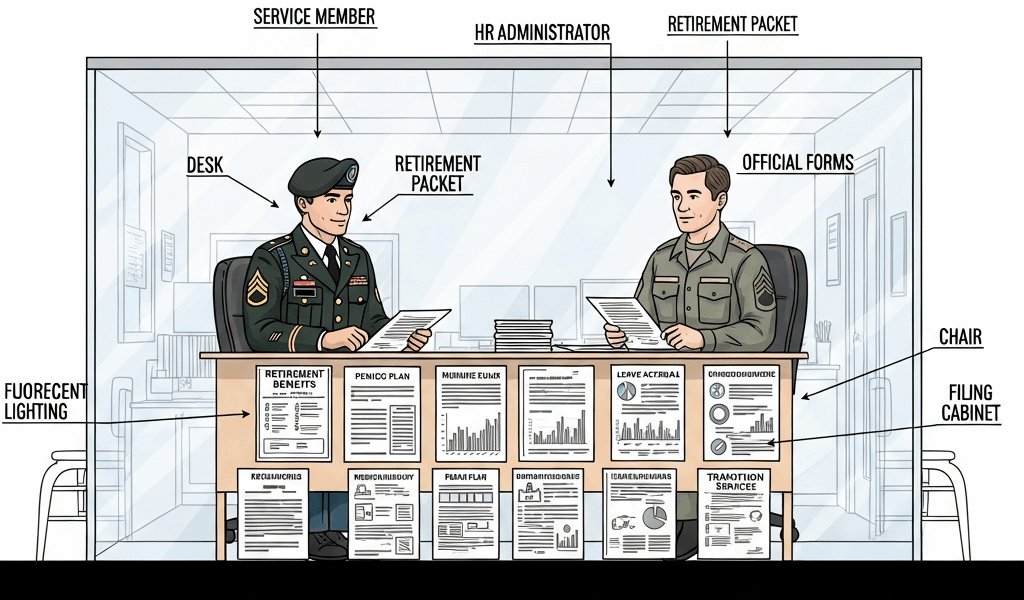
The Army has made it official. After nearly three years of pilot programs and temporary extensions, the service has permanently changed when soldiers can submit voluntary retirement requests — and the new timeline is significantly wider than what most troops were used to.
Under the rule reported April 28, 2026, soldiers must submit voluntary retirement requests no earlier than 24 months and no later than 12 months before their preferred retirement date. The old window was 9 to 12 months prior to the desired retirement date. That standard had been in place before a pilot program launched January 1, 2023 under MILPER Message 22-493, which set the pilot window at 9 to 24 months. The permanent policy raises the minimum from 9 months to 12 months.
What Changed and Why
The pilot didn’t just run once. It was extended multiple times — through January 11, 2025 via MILPER 24-012, then through September 2025, then again through September 2026 via a memo from Deputy Chief of Staff, G-1, Lt. Gen. Brian Eifler. As of late April 2026, the Army locked it in as standing policy rather than continuing what had become a recurring exception-to-policy cycle.
The rationale is straightforward: workforce management and soldier welfare. Army officials say the expanded window lets the service better predict personnel losses, synchronize movement cycles, and give soldiers more time to manage their transitions. That last piece traces back to a 2022 Government Accountability Office finding — a damning one — that 70 percent of active-duty service members started their Transition Assistance Program (TAP) less than one year before separation. Far too late to do it right.
Who This Affects
The policy covers all Regular Army soldiers and Active Guard Reserve (AGR) soldiers planning voluntary retirement. Eligibility requires 18 or more years of active federal service (AFS) and the ability to complete all service obligations by the requested retirement date. Soldiers with fewer than 19 years of AFS won’t have their retirement approved if they’re under consideration for — or have already been selected for — an assignment.
OCONUS soldiers face an additional step. They must request a Foreign Service Tour Extension (FSTE) to align their Date Eligible to Return from Overseas (DEROS) with the approved retirement date, and that request has to accompany the retirement packet.
How to Submit — and What Not to Get Wrong
All voluntary retirement requests go through the Integrated Personnel and Pay System — Army (IPPS-A) as a Personnel Action Request (PAR), routed through the chain of command and endorsed by the first O-6 in the soldier’s chain. That O-6 endorsement is required. No exceptions.
Richard A. Meyer, chief of Retirements and Separations at HRC’s Force Shaping Directorate, spelled out the most common mistake soldiers make:
A common mistake soldiers make is routing their retirement PARs directly to HRC and bypassing their local Retirement Services Office. Although HRC is the approving authority for retirement requests, the RSO is responsible for preparing the service computations and ensuring retirement requests meet regulatory and statutory requirements.
Start with your S1 — they’ll provide the required document checklist for the PAR. From there, the PAR routes to your post’s Retirement Services Office before it ever reaches HRC. Skip that step and your packet comes back.
Requests falling outside the 12-to-24-month submission window require a letter of lateness from the first O-6 in your chain of command. Packets without it will be returned without action.
What Soldiers Should Be Doing Right Now
If you’re within the 12-to-24-month window before your target retirement date, your packet should already be in process or submitted. The 6-to-12-month window is when DD Form 2648 (Pre-Separation/Transition Counseling) gets completed through Army TAP. The 1-to-6-month window is when your Survivor Benefit Plan (SBP) election needs to be made. That decision is permanent once finalized.
Policy for enlisted retirements is governed by AR 635-200; officer retirements fall under AR 600-8-24. Detailed planning checklists are available at soldierforlife.army.mil.
For soldiers approaching or already past 20 years under the Blended Retirement System — which launched in 2018 — 2026 marks the first major wave of BRS retirements. The lump-sum versus monthly payment decision under BRS is also permanent once made. Financial counseling during the transition window isn’t optional; it matters.
Watch for a follow-on MILPER message from HRC formalizing procedural guidance under the permanent policy. The G-1 memo confirming the October 2025 extension noted that “procedural guidance will be published by HRC via MILPER message” — that formal publication under the permanent rule should be forthcoming.



Leave a Reply