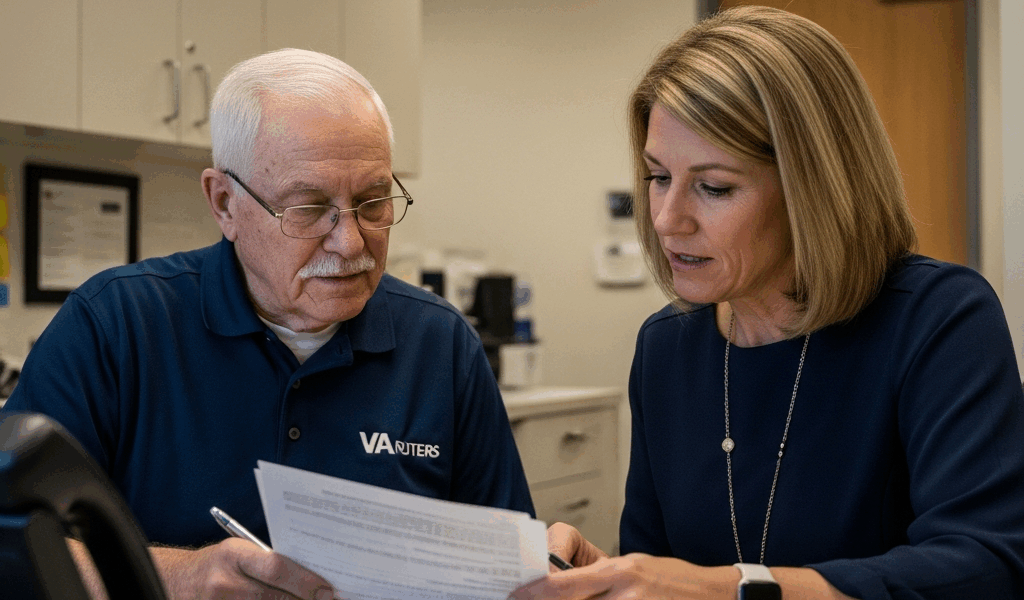
A coalition of 35 major veterans service organizations went on record April 29, 2026, demanding Congress pass legislation that would require the Department of Veterans Affairs to obtain written informed consent from veterans before prescribing certain high-risk psychiatric medications. Right now, VA providers can satisfy their disclosure obligation with a verbal conversation — and Inspector General findings show that conversation often isn’t happening at all.
The Bill — What It Would Change
The Written Informed Consent Act (H.R. 4837 / S. 3314) would require VA providers to give veterans a standardized written consent form before prescribing antipsychotics, stimulants, antidepressants, anxiolytics, and narcotics carrying FDA warnings related to suicide risk. Veterans would also receive a written summary of risks, benefits, and alternative treatment options. If a veteran declines, that refusal gets documented in their chart.
Written informed consent at the VA currently applies to treatments and procedures involving significant or unusual risks, including certain psychiatric and pain management medications, under VHA Handbook 1004.01. This bill would extend that same documented process to hundreds of additional medications — a significant expansion, given that nearly 70% of veterans in VA care are prescribed psychiatric medications, according to the Grunt Style Foundation.
Rep. Gus Bilirakis (R-FL), Rep. Jack Bergman (R-MI), and Rep. Keith Self (R-TX) introduced H.R. 4837 on August 1, 2025. The Senate companion bill, S. 3314, came from Sen. Tim Sheehy (R-MT) on December 3, 2025. The House bill has 19 cosponsors — among them Rep. Don Davis (D-NC), an Air Force veteran who also participated in the April 28–29, 2026 press conference and coalition event. Both bills are stalled in their respective Veterans’ Affairs Committees.
Why VSOs Are Pushing Hard Now
The coalition — which includes the American Legion, DAV, VFW, IAVA, TAPS, and 30 other national organizations — sent a formal letter to House and Senate Veterans’ Affairs Committee leadership in late April and held a Capitol Hill press conference on April 29. After no committee action followed, a renewed push was published May 6, 2026.
“The legislation will ensure veterans are fully informed about a drug’s risks, leaving no doubt about what information veterans are or are not provided.” — 35-VSO coalition letter to Congress
IAVA VP of External Affairs Lou Elliott-Cysewski put it plainly:
“We would never sign a mortgage or a car loan without seeing the terms in writing, yet we routinely ask veterans to say yes to powerful mind-altering drugs with nothing more than a quick conversation.”
The VFW’s Meggan Coleman, Associate Director of National Legislative Services, noted that written consent is already standard for routine procedures requiring anesthesia. The argument isn’t complicated — if a colonoscopy requires paperwork, high-risk psychiatric drugs should too.
The IG Paper Trail — Documented Failures
This isn’t theoretical. VA Office of Inspector General reports from 2024 and 2025 found a lack of documentation showing VA prescribers discussed medication risks and benefits with patients at facilities in Georgia, Pennsylvania, Virginia, and Massachusetts. Supporters also point to a 2018 GAO report finding that requiring written consent for long-term opioids directly reduced that class of prescribing — evidence, they argue, that the model works.
Who’s Pushing Back
Opposition surfaced in December 2025, when the American Psychiatric Association, the American Academy of Family Physicians, and the National Association of Social Workers wrote to committee leaders arguing the bill “risks creating unintended barriers to timely treatment and duplicating existing processes” under VHA Handbook 1004.01. The VA declined to comment, citing pending legislation.
Retired Army Colonel and 32-year military physician Charles Garbarino raised a practical concern — though he does not oppose the bill — that confronting veterans with a detailed list of adverse effects may discourage some from taking medications that could genuinely help them. “Leaving a serious mental health problem untreated can lead to suicide,” Garbarino said.
What Veterans Should Watch For
As of May 7, 2026, both H.R. 4837 and S. 3314 are awaiting committee action with no scheduled markup or vote. Veterans currently prescribed antidepressants, antipsychotics, anxiolytics, stimulants, or narcotics through the VA already have the right under existing VA policy to request written documentation of risks, benefits, and alternatives before starting or continuing treatment — regardless of whether this bill passes.
The VSO coalition letter is on record. Congressional response is the next variable. Veterans who want this bill to move can contact their representatives on the House and Senate Veterans’ Affairs Committees directly.



Leave a Reply